
Team-X Playbook
Operational excellence begins with creating work systems that acknowledge the differences across your team and enable your unique collective strengths to emerge. Using the insights and recommendations in this Team-X Playbook you'll discover practical ways to adjust your team's structures, communication patterns, and collaborative processes to play to your collective strengths and set you up for success. Team-X accelerates your journey to peak performance with each deliberate change you make.
Executive Summary
The big picture
Translate great ideas into sustainable results by speaking to align, and writing to commit.
1. Introduction
What is the Team-X Playbook?
This Team-X Playbook is your team's operating manual, powered by data from each member's Biodex1 data combined with proprietary AI and proven performance strategies. It reveals hidden dynamics and tensions at a point in time while providing practical actions to remove barriers to collaboration. Think of it as a navigation system for working together, helping everyone adapt to a variety of work styles to achieve shared goals.
Core Principles that Drive this Playbook
- Each Person has a Base State: Everyone comes to work with habits, preferences, and expectations. The way we respond to our colleagues is influenced by the good and bad experiences we've had throughout our lives and careers. We're all at the mercy of deeply ingrained habits and working styles reinforced over years.
- There are Things We CAN'T Change: While we can grow and improve ourselves, we can't change others' core traits — especially within a typical 2–5 year job tenure. Workplace friction usually stems from expecting others to change rather than accepting who they are. The key is redirecting that energy from trying to change people to improving the systems they work within.
- There are Things We CAN Change: We can adjust our work systems to close the gaps between how we process information and make decisions. While we can't rewire someone's natural approach, we can adjust how we work together, including our communications styles, meeting protocols, access to knowledge, and more.
By adapting the way we work rather than trying to change people, we create environments that naturally bring out the best across our team.
How this Team-X Playbook is Organized
The Playbook has been customized for your team's unique preferences and needs, based on Biodex data collected from each team member, and evaluated in the context of evidence-based practices. These approaches have been shown to remove barriers to peak performance for teams like yours by helping you remove potential barriers to collaboration and hidden tensions. The Playbook includes:
- 1. Introduction: An overview of what's in this Playbook and how to use it.
- 2. Base State: An analysis of the underlying drivers of the dynamics of your team, which are unlikely to be changed by typical training programs or workshops — covering Adaptation Patterns (how members respond to daily tensions and self-regulate), Engagement & Voice (how comfortable people are getting their ideas heard and acted upon), and Hidden Tensions (potential tensions to watch for, with customized ways to strengthen collaboration).
- 3. Team Biodex: An analysis of how the unspoken norms within your team might impact how people perceive and respond to each other, plus a brief description of how to use your AI personas to close operational gaps when introducing AI into day-to-day workflows.
- 4. Actions: A priority area to focus on as a team, and a short list of practical actions to consider based on proven practices that have benefited other teams with profiles similar to yours.
Using the insights here, your team can remove barriers to collaboration and get better results faster.
Conventions Used
Several conventions are used in this Team-X Playbook to help you quickly identify which parts of the analysis are unique to your team, and which parts describe the more universal aspects of Team-X.
2. Base State
What is Your Team's Base State?
People don't change easily, and change takes time. As you look to improve the way your team works together, it's important to understand the things that won't change quickly. We call that your team's Base State.
Trying to guess what's really going on under the surface or "fix" things that are beyond your control can not only cause you unnecessary worry, but waste a lot of your time. This section of your Team-X Playbook will help you better understand the dynamics of your team, especially the things you can't change quickly. This includes team members' natural work styles, resilience to stressors, levels of trust, and the impact of positive and negative experiences from their past.
This conscientious team is stretched thin by heavy workloads, creating stress and reactivity that undermines their ability to perform. While generally resilient and open to collaboration, they struggle with unclear priorities and frequent context switching. Excessive meetings will disrupt productivity. The team values clear communication and mutual accountability but faces challenges when members don't follow through on commitments or communicate problems early enough. They need transparent goal-setting, timely feedback, and decisions made collaboratively with genuine consideration of perspectives. Most learn independently through online resources and hands-on exploration, requiring uninterrupted focus time. Recognition matters too: they want contributions acknowledged and ideas seriously discussed. Success depends on establishing consistent processes, respecting boundaries during deep work, eliminating unproductive meetings, and fostering open dialogue where concerns are addressed directly without delay.
Adaptation Patterns
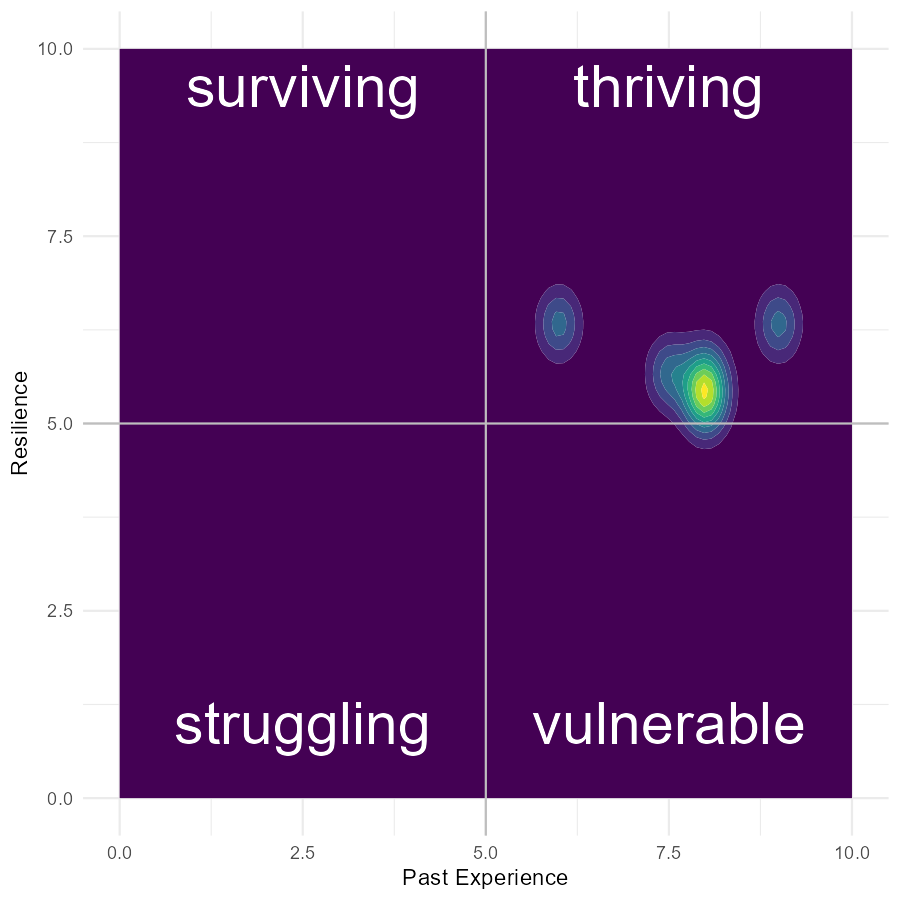
Understanding how teams adapt to challenges based on their past experiences and natural resilience levels allows us to implement strategies that enhance team performance and well-being. By identifying where most experiences appear on this grid, teams can learn to grow stronger through challenges rather than being diminished by them.
Reading the grid
The right half indicates generally supportive scenarios: kind and reasonable managers, more healthy power dynamics, and little or no retaliation. Towards the top, team members have effectively adapted to and self-managed stress.
Mostly struggling: Establish check-ins where people can discuss what's not working and collaborate on solutions. Leaders should affirm healthy boundaries around workload and availability.
Mostly vulnerable: Proactively strengthen the team's resilience through mentorship pairings and small-win projects, catching potential issues before they become real problems.
Mostly surviving: Acknowledge and learn from past challenges while deliberately creating new, positive team experiences. Don't let challenges from other work experiences define this team's future.
Mostly thriving: This team has had its share of ups and downs, but your natural resilience helps get you through the tough times. Continue mitigating external stressors and balancing individual needs for flexibility whenever possible.
Engagement & Voice
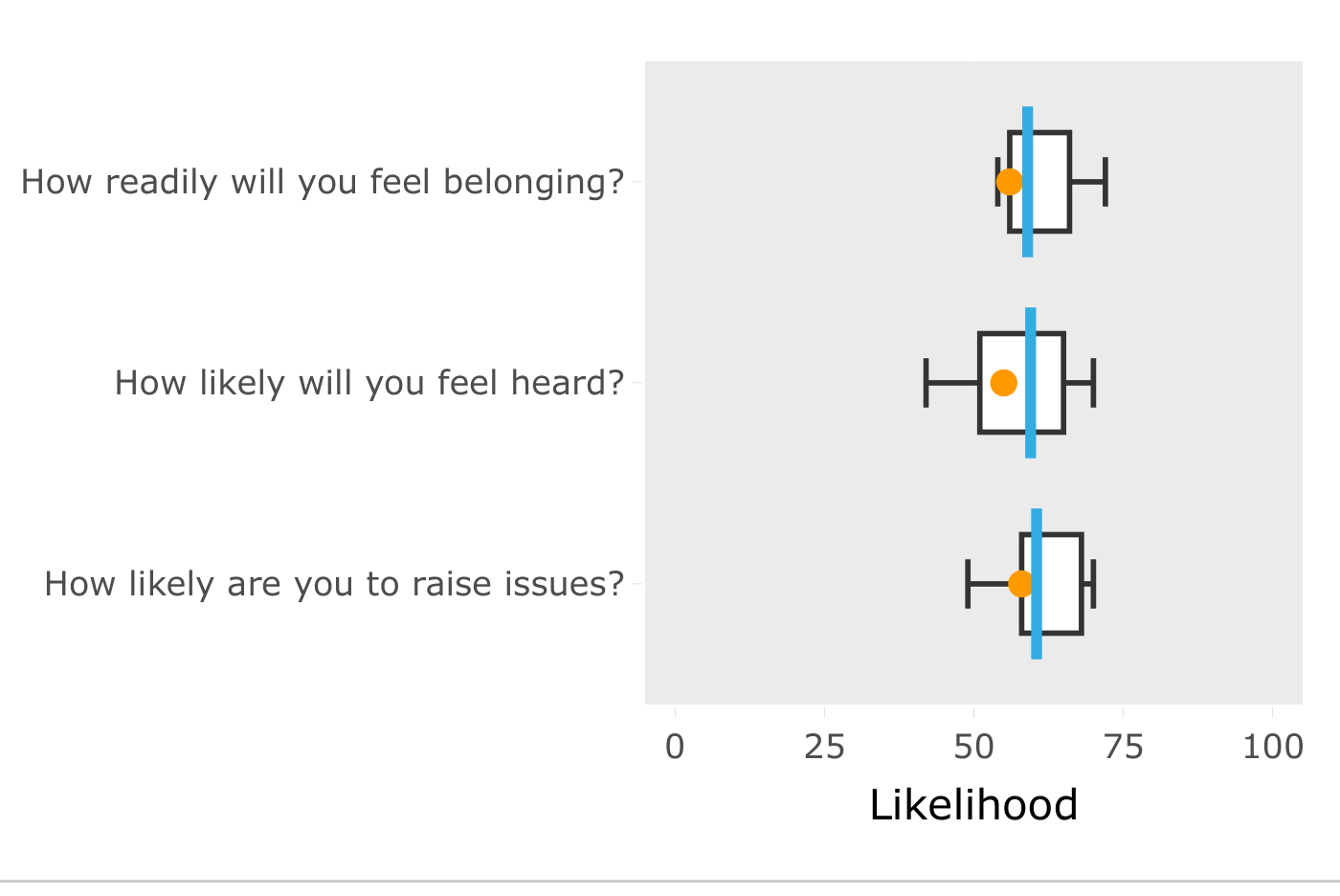
A person's willingness to raise issues is strongly linked to whether they believe their concerns will be heard. If you know your concerns will be well received, you are more inclined to voice them. If you feel like change never happens, you may be less likely to raise issues. This dynamic can carry over from one workplace to the next, even when a team member has no basis to believe that their input will not matter.
Reading the box plot
The majority of responses fall in the white box, and the lines extending left and right show variability. Smaller boxes appear when teams more naturally understand each other, while larger boxes suggest more space for hidden tensions to develop.
The orange dot is the median value from your team, while the blue line is the median across all benchmarked teams. If the orange dot lies to the right of the blue line, it may be easier for this team to develop a culture of collaborative excellence.
Base states vary in all teams. While one or two more extroverts will readily raise and resolve issues, one or two others need time and space to build trust and communicate effectively.
Identifying Hidden Tensions
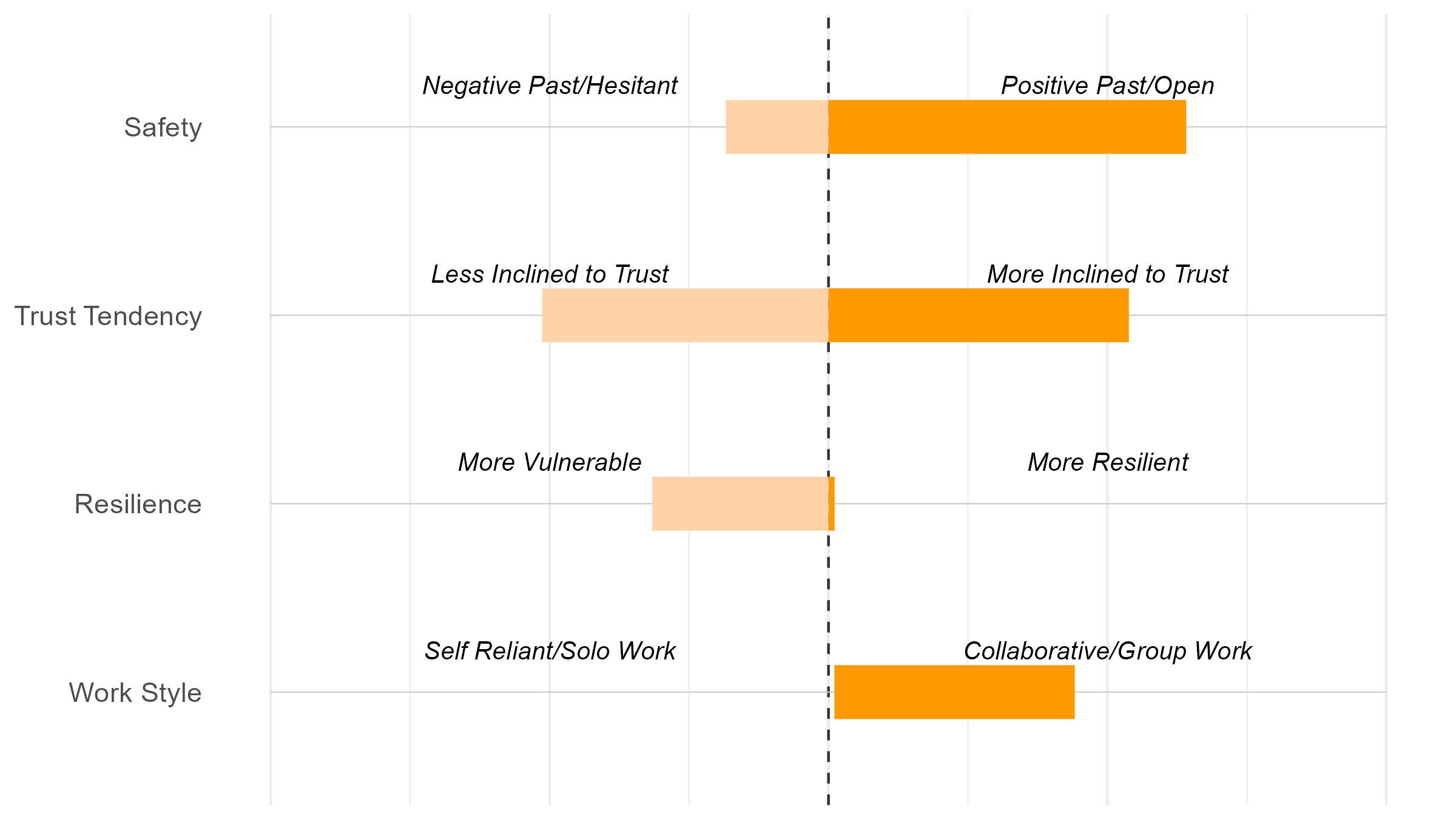
How do the work preferences across your team compare to other teams? The dashed vertical line shows the median value for this indicator across our national benchmark of teams. Wide variations in preferences can indicate hidden tensions within the team.
Responding to Hidden Tensions
By examining how the variation in Work Style, Resilience, Trust Tendency, and Safety vary within your team — and comparing it to our national benchmarks — we can identify how different value systems and habit patterns cause stress in places you might never expect.
Tension
Team members prefer talking and real-time interaction but want to receive communications in writing, creating a mismatch between how people want to express themselves versus how they want to consume information from others.
Rationale
Five of six members prefer communicating by talking, yet five prefer receiving communications in writing. This asymmetry means everyone wants to talk but nobody wants to listen synchronously, causing potential communication friction and delays.
Resolution
Establish a hybrid protocol: use brief synchronous discussions for collaboration and decision-making, followed by written summaries for documentation. This honors both the desire to talk and the need for written reference materials.
3. Team Biodex
What is the Team Biodex?
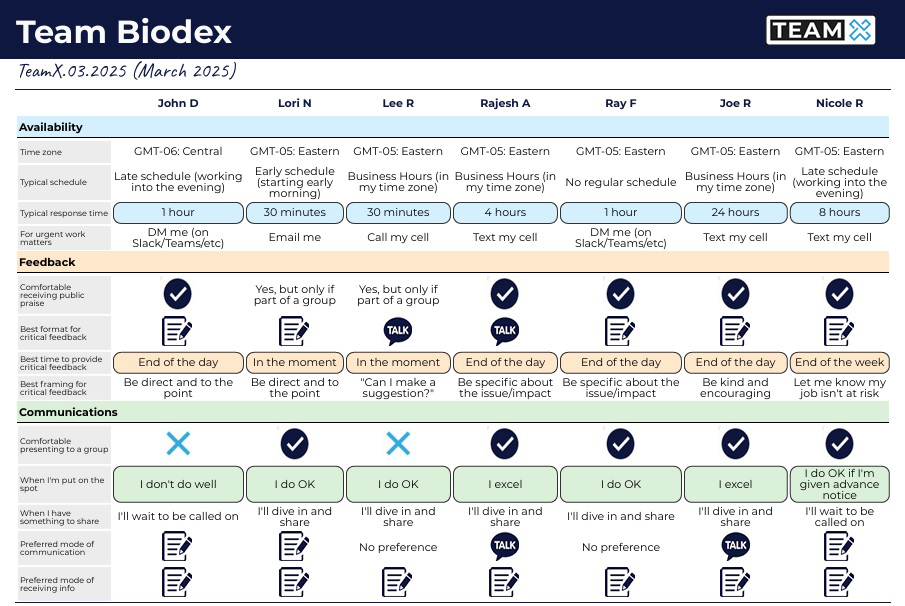
Your Team Biodex is a cheat sheet for understanding work styles across your team. It's based on a subset of Biodex data from each team member, and shows stated preferences that are most useful for helping colleagues understand each other at work. Review your Team Biodex, including the team summary and individual profiles, to better understand your teammates' preferences in terms of availability, feedback and communication. The Team Biodex is a different artifact than the Team-X Playbook you are currently reviewing.
What to look for
By observing how people are similar and different, you can identify unspoken norms that may be holding your team back. Based on these patterns, your team can take focused actions to collaborate more easily and achieve more together. For example:
Feedback Style Conflicts: Interactions between people who prefer direct vs. indirect feedback can be filled with hesitation.
Response Time Expectations: Quick responders may feel constrained by people with longer response times, and vice versa.
Participation Pattern Imbalances: Quieter team members may feel consistently overshadowed in teams dominated by "dive in" people.
Identifying Unspoken Norms
Different work habits and preferences can create invisible friction when teammates interpret these variations through their own lens. Someone who responds quickly might see delayed responses as disengagement, while someone who needs long periods of focus might become irritated by frequent interruptions. These mismatched expectations often go unaddressed because each person assumes their way of working is "normal," leading to quiet resentment and eroded trust rather than discussing valid differences in work styles.
- Deadline Flexibility Divide: Team splits between strict deadline adherence and flexible timing preferences, creating potential conflict around project timelines and accountability expectations.
- Communication Mode Mismatch: Diverse preferences for meetings versus written communication suggest unspoken tension about how information should be shared and decisions made.
- Autonomy Versus Collaboration: Team members vary significantly between preferring independent work and collaborative approaches, potentially causing friction in project structure and interaction frequency.
Responding to Unspoken Norms
Addressing unspoken norms is crucial because beliefs and invisible expectations often drive team behavior more powerfully than formal policies. When left unexamined, these implicit rules can create misunderstandings, resentment, and burnout as team members struggle to meet conflicting expectations they didn't explicitly decide upon or agree to. By bringing these norms into the open, teams can consciously redesign them to support well-being and effectiveness as a team, transforming potential friction points into shared agreements that everyone understands and has committed to honoring.
- Structured Flexibility: Implement core deadlines for interdependent tasks with buffer zones for individual work, creating a hybrid system that honors both strict timeline adherents and those needing flexibility while maintaining accountability through transparent progress tracking.
- Communication Protocol Matrix: Establish clear guidelines specifying which situations require meetings (collaborative decisions, complex problem-solving) versus asynchronous written updates (progress reports, individual concerns), with a "no unnecessary meetings" policy that respects deep work time while ensuring critical information flows effectively.
- Collaborative Autonomy: Design project workflows with defined independent work phases and scheduled collaboration checkpoints, allowing autonomous workers uninterrupted focus time while building in regular touchpoints for collaborative members to share ideas, provide feedback, and make joint decisions.
- Early Warning System: Create a simple, standardized way for team members to flag blockers, delays, or challenges immediately through a shared channel, preventing late problem discovery while respecting individual work styles and reducing the need for constant check-ins.
- Recognition and Feedback Ritual: Schedule brief, purposeful team sessions to acknowledge contributions, discuss decisions collaboratively, and provide clear feedback, ensuring everyone feels heard and seen without adding unnecessary meetings to the calendar.
Working with Your AI Personas
Each of us makes requests, defines boundaries, and provides context differently. While these are important for working with humans, they're essential for working with AIs. Natural work styles and preferences highlight where your judgment and creativity can make the biggest impact as you integrate AI into day-to-day workflows.
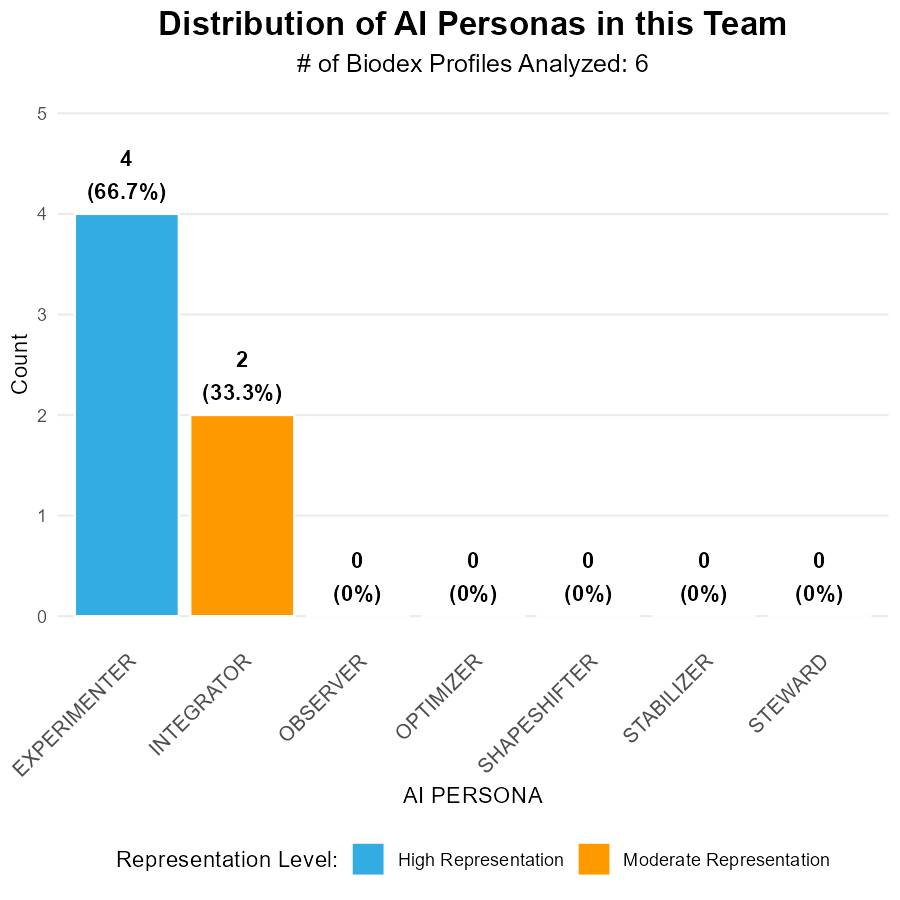
What this means
This team leans heavily toward innovation and collaboration, but needs to develop the discipline to drive sustained results from their new ideas.
Strengths: High enthusiasm and positive attitudes toward AI adoption that can energize broader organizational buy-in; natural inclination toward brainstorming, prototyping, and tackling unfamiliar problems; likely to be early adopters who push boundaries and discover unexpected AI use cases.
Opportunities for improvement: Ideas may proliferate without risk awareness or process discipline, making it hard to translate experiments into sustainable, implemented solutions.
The two Integrators should take on dual responsibility: one should develop Steward-like competencies around ethical review and compliance, while the other cultivates Optimizer habits to create structure and accountability for AI initiatives. At minimum, one Experimenter should try on an Observer mindset during project reviews, asking "what could go wrong?" before implementations proceed. The team should also establish external checkpoints (whether through cross-functional reviews, advisory input, or formal governance processes) to compensate for the missing personas that would normally provide caution, stability, and operational rigor.
4. Actions
About the Focus Areas & Practices
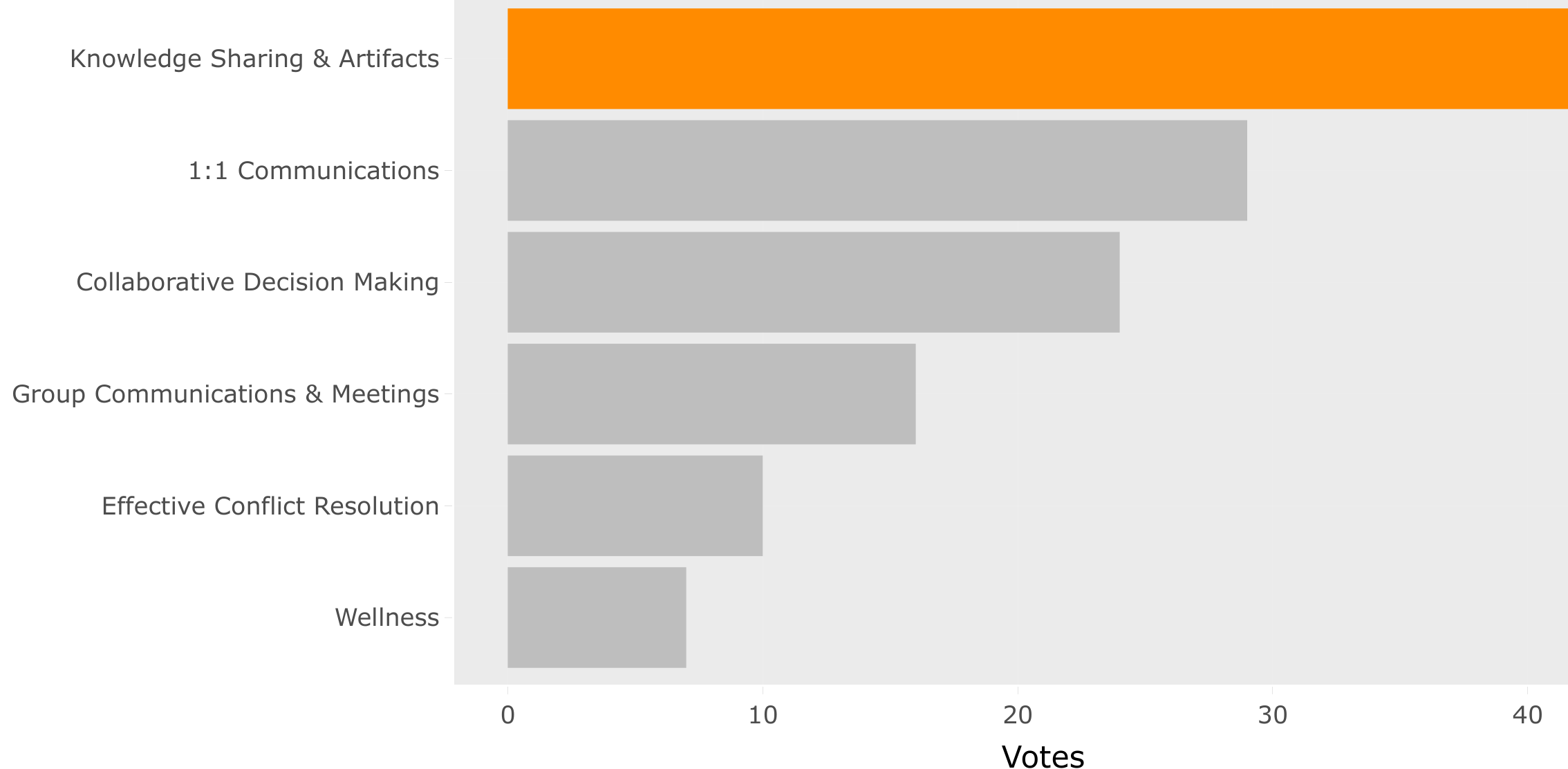
There are six categories of collaborative practices where practical actions can directly enhance team cooperation and performance. These potential areas of focus are:
While most teams have room for improvement in several areas, making changes requires time and effort. The Team-X analysis process helps you narrow your focus to the categories that can benefit you the most right now, and selects work practices that support your top focus areas. This section concludes with a synthesis of how your team's base state, work habits and preferences, hidden tensions, unspoken norms, and automatically recommended practices all point towards a single direction you can pursue to amplify your team's performance.
Focus Areas Selected for This Team
To reduce friction and cognitive load, and to improve collective sensemaking, Team-X analysis reveals which categories of improvements will have the greatest impact on your team's performance. Based on the current needs, context, and unique membership of this team, the following categories have been highlighted:
Practices Recommended for This Team
The following Universal Practices have been automatically selected by Team-X from our catalog based on your team's unique preferences, needs, and performance priorities. These practices highlight the focus area that Team-X analysis determined was most promising for your team. They have been incorporated into evaluating your current state and synthesizing recommendations for the highest impact action you can take now.
Synthesis
This Team-X Playbook examined patterns within and between each team member's Biodex data, combined with proprietary AI and the connections between observed patterns and proven performance strategies. This analysis reveals hidden dynamics and tensions, and provides practical recommendations to enhance collaborative performance.
Translate great ideas into sustainable results by speaking to align, and writing to commit.
Based on the data, the highest value action this team can take is establishing a hybrid communication protocol that transforms how ideas become results. This team has the enthusiasm, collaborative instincts, and creative energy to innovate, but loses momentum when conversations don't translate into documented commitments. By using brief synchronous discussions to align and make decisions, then following up with written summaries to lock in accountability, the team can reduce friction, protect deep work time, and build the execution discipline their ideas deserve. Clear priorities, transparent progress tracking, and consistent recognition will further strengthen a culture where great thinking leads to changes that stick.
The way you work, just like the results you produce, can be continuously improved by taking one or two targeted actions at a time. Let this Team-X Playbook guide you to a deeper understanding of your team's dynamics, and in particular, to practical actions that remove hidden barriers to collaboration and unlock your team's full potential.
Good luck!
1 Biodex, developed by Ultranauts Inc, is a "user manual" to help colleagues more easily adapt to each other's work styles and communication preferences.